Establish the Design Basis
Understand the client requirement, site, existing supply, loads, architecture and available solar resource before selecting equipment.
Modules 01 to 05SOLAR DESIGN ENGINEER'S TOOLKIT
Design Residential Solar PV Systems With a Complete Engineering Workflow You Can Calculate, Verify and Defend.
A complete residential solar design system for engineers who want a process they can calculate, document and review.
Move beyond equipment sizing and rule of thumb design. The Solar Design Engineer's Toolkit gives you a structured engineering workflow for taking a residential solar project from client requirements and load assessment through system architecture, sizing, compatibility checks, electrical safety, documentation and commissioning.
Built for Grid Connected, Hybrid and Standalone Residential PV Systems.
Get the Complete Toolkit Toolkit + Engineering Workbook + 3 Complete Worked CasesSTANDARD PRICE: $79 USD · One Time Payment
WHY THE TOOLKIT EXISTS
A client request should not begin with panel quantity, inverter rating or battery capacity.
The designer must first understand the client requirement, site, existing supply, load behaviour, hourly energy profile, operating modes and system constraints.
The equipment is the result of the design process. It should not be the starting point.
THE ENGINEERING SYSTEM BEHIND THE TOOLKIT
Instead of jumping between isolated calculations, the Toolkit takes you through one connected engineering process.
Every stage produces information required by the next stage. That is how the design becomes traceable, coordinated and defensible instead of a collection of disconnected calculations.
The goal is not simply to arrive at an equipment size. The goal is to produce a design that another competent person can follow, check and defend.
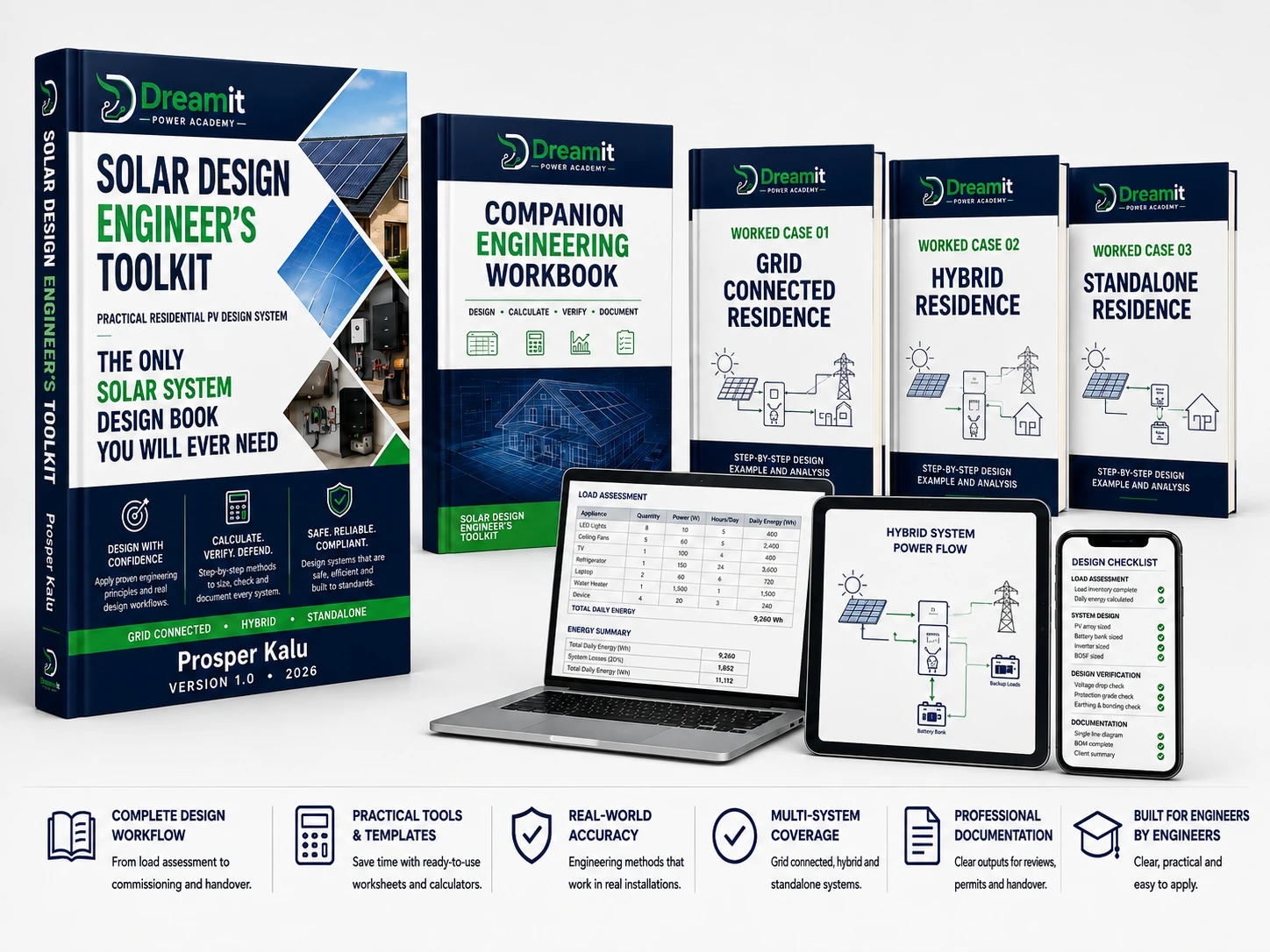
THE COMPLETE DESIGN SYSTEM
Solar Design Engineer's Toolkit
The complete engineering workflow and practical design
handbook.
Companion Engineering Workbook
The working calculation and verification system that follows the
Toolkit process.
Worked Case 01
Grid Connected Residence
Worked Case 02
Hybrid Residence
Worked Case 03
Standalone Residence
5 coordinated resources. One engineering workflow.
Understand the client requirement, site, existing supply, loads, architecture and available solar resource before selecting equipment.
Modules 01 to 05Develop coordinated PV, battery, inverter, charging, cable, protection and installation designs.
Modules 06 to 11Evaluate performance and economics, prepare the controlled design package and establish commissioning and handover requirements.
Modules 12 to 14Follow three complete residential projects from project brief through final design decision.
Grid Connected · Hybrid · StandaloneDO NOT JUST READ IT
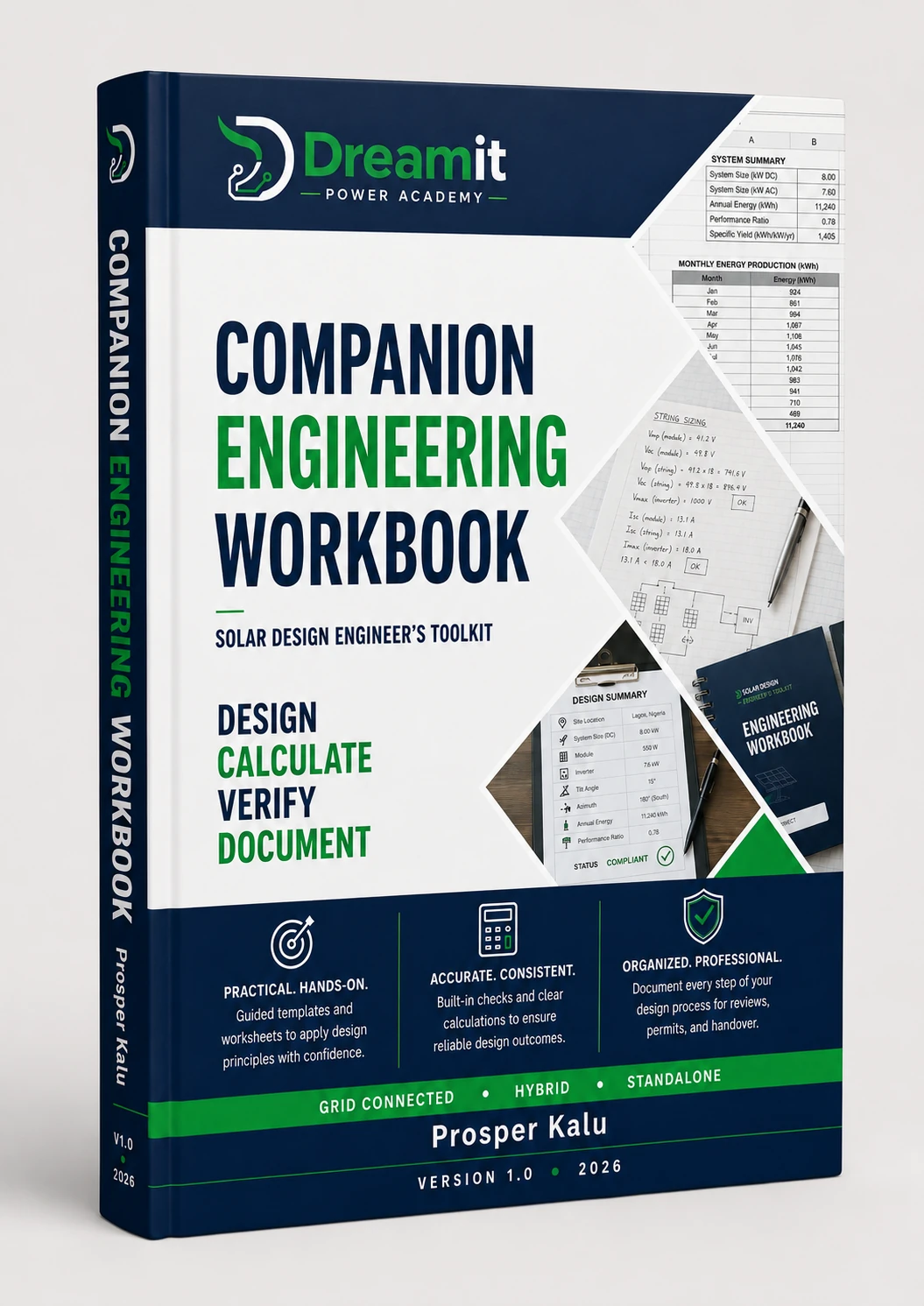
The Companion Engineering Workbook turns the Toolkit from a reading resource into a practical working system. As you progress through a project, you can enter and organise project information, develop the load profile, perform system sizing, verify equipment and circuit requirements, prepare the bill of quantities and review the final design outputs.
Read the principle in the Toolkit. Apply it in the Workbook. Verify it before carrying the design forward.
A Grid Connected system is not designed exactly like a Hybrid system. A Hybrid system is not designed exactly like a Standalone system. The underlying engineering process remains consistent, but the controlling design conditions change.
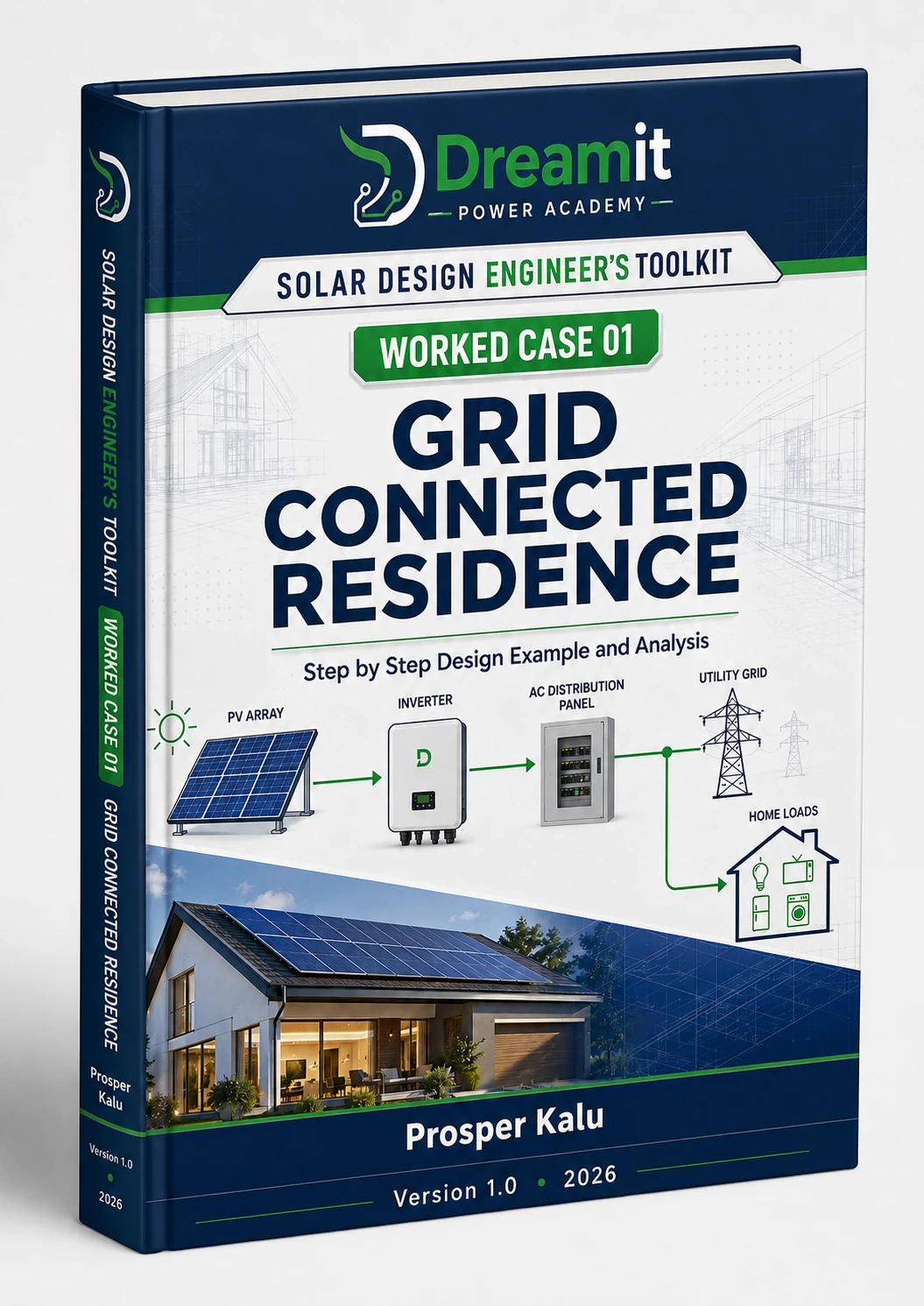
Learn how the workflow changes when the objective is primarily self consumption, utility interaction and permitted export without battery storage.
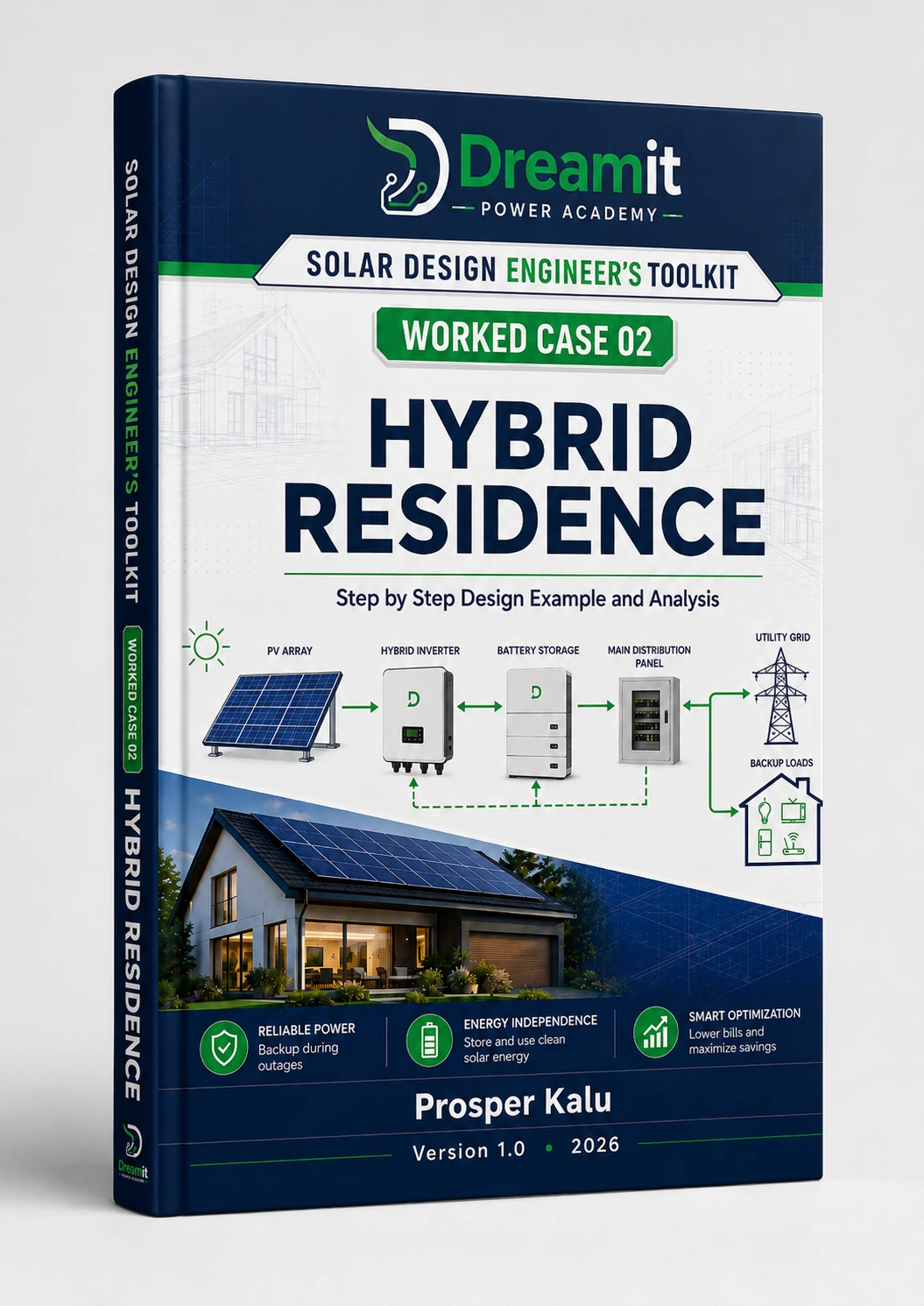
Follow the coordination of PV, battery storage, utility supply, generator support, backup loads and operating modes.
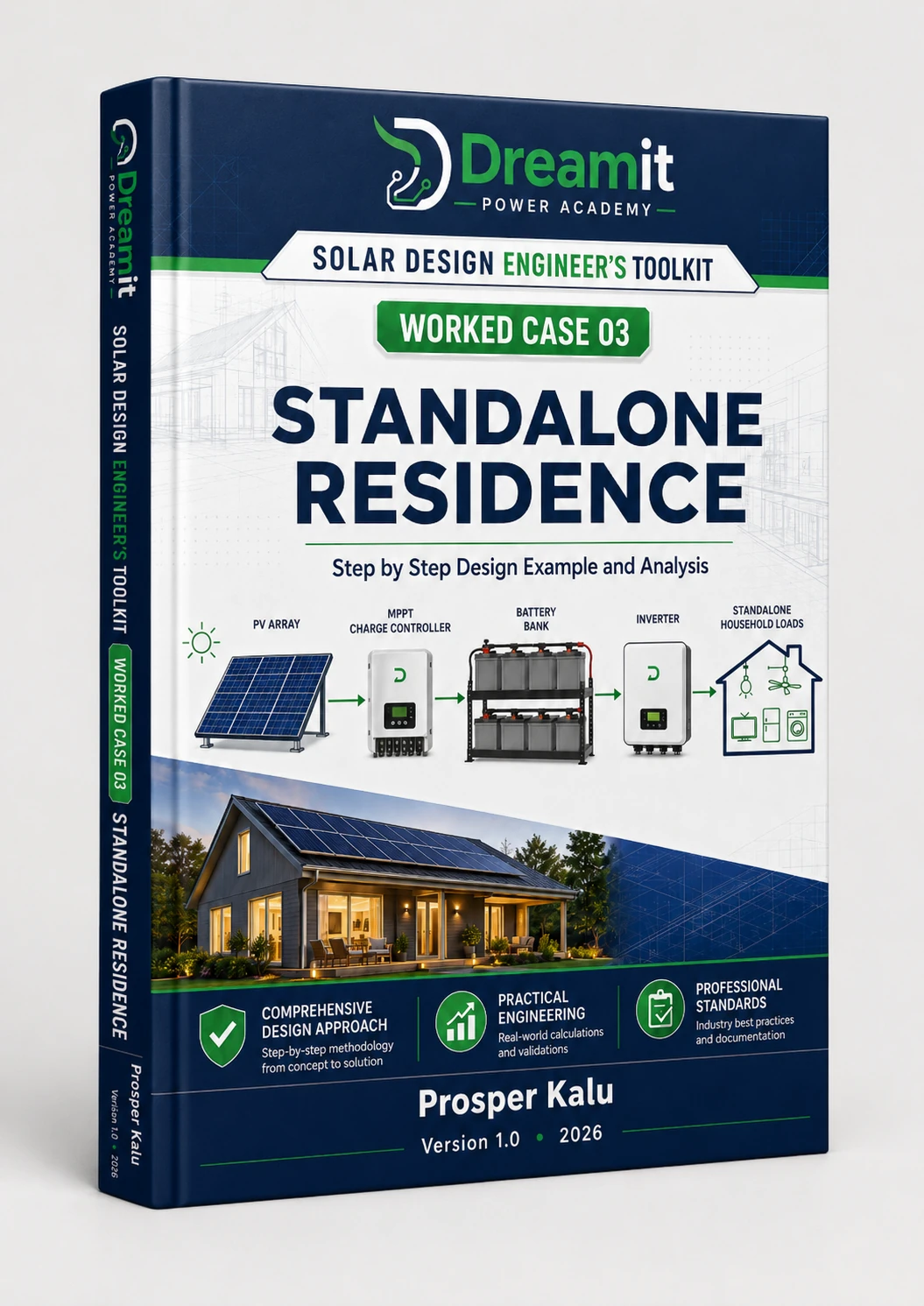
See how the design changes when PV, storage and generator support must supply a residence without a normal utility connection.
The Toolkit gives you a workflow. Engineering judgement still belongs to the designer.

BUILT FROM AN ENGINEERING PERSPECTIVE
Prosper Kalu is an electrical engineer and renewable energy practitioner with practical experience in solar PV design, electrical systems, power management and energy efficiency.
He is the cofounder of Dreamit Technology Ltd, an engineering and energy consultancy focused on reliable power systems, energy transition and energy efficiency, and the founder of Dreamit Power Academy, where he focuses on practical engineering education for engineers, technicians and energy professionals.
The Solar Design Engineer's Toolkit reflects his approach to solar design as a complete engineering workflow, from client requirements and load assessment through sizing, verification, documentation and commissioning.
Connect on LinkedInPARTICIPANT FEEDBACK
These messages reflect participant experiences with Dreamit Power Academy’s solar design training. The Toolkit follows the same structured, engineering led approach used throughout our learning programmes.
LEARNING IN ACTION
The Dreamit Power Academy learning community applies the same engineering process reinforced throughout the Toolkit. Participants are encouraged to assess client needs, work through calculations and explain the reasoning behind their design decisions.
GET THE COMPLETE SYSTEM
Solar Design Engineer's Toolkit · Companion Engineering Workbook · Grid Connected Residence Worked Case · Hybrid Residence Worked Case · Standalone Residence Worked Case
Grid Connected • Hybrid • Standalone
STANDARD PRICE
$79 USDOne Time PaymentGet the Complete Toolkit for $79 USDThis is a digital professional education and design support package. Before purchasing, you can review the product structure, sample pages, workbook previews, worked case examples and file formats directly on this page.
The Toolkit is intended to support engineering education and professional design work. It does not replace applicable laws, codes, standards, utility requirements, manufacturer instructions or the judgement of a competent professional.
View Licence and Use TermsYes. The Toolkit explains the workflow progressively while retaining the technical depth required for serious engineering work.
No. The Toolkit was developed for a global audience and covers Grid Connected, Hybrid and Standalone residential PV systems. Local requirements must still be verified for every project.
No. The package includes the main Toolkit, a Companion Engineering Workbook and three complete worked case workbooks.
A PDF reader for the Toolkit and Microsoft Excel or compatible spreadsheet software for the workbooks.
Yes. The single user licence allows the purchaser to use the Toolkit and workbooks for personal learning and professional design work.
No. The licence is for the original purchaser. Files may not be redistributed or shared without written permission.
No. Applicable electrical standards, utility requirements, manufacturer instructions and jurisdiction specific requirements remain controlling.
Yes. Battery energy, power, current, charging, BMS communication, installation limits and equipment compatibility are covered.
Yes. Generator rating, charging interaction, source coordination, operating logic and protection interfaces are included.
Yes. The Toolkit includes circuit definition, current calculations, cable capacity, voltage drop, isolation, overcurrent protection, earthing and other electrical safety considerations.
Successful payment will provide digital access to the product files.
YOUR NEXT DESIGN CAN BE DIFFERENT
Begin with the requirement. Understand the load. Define the architecture. Calculate the system. Verify the interfaces. Document the decisions. Then select the equipment that satisfies the design.
Get the Complete Toolkit Immediate digital access • No subscription • Professional single user licence